Richmond students consider a wide range of perspectives and vigorously exchange ideas. Whether through thought-provoking talks or intentional spaces for respectful discussion, Spiders question their assumptions and deepen their understanding, developing invaluable skills and knowledge they can put into practice.
Considering Diverse Viewpoints
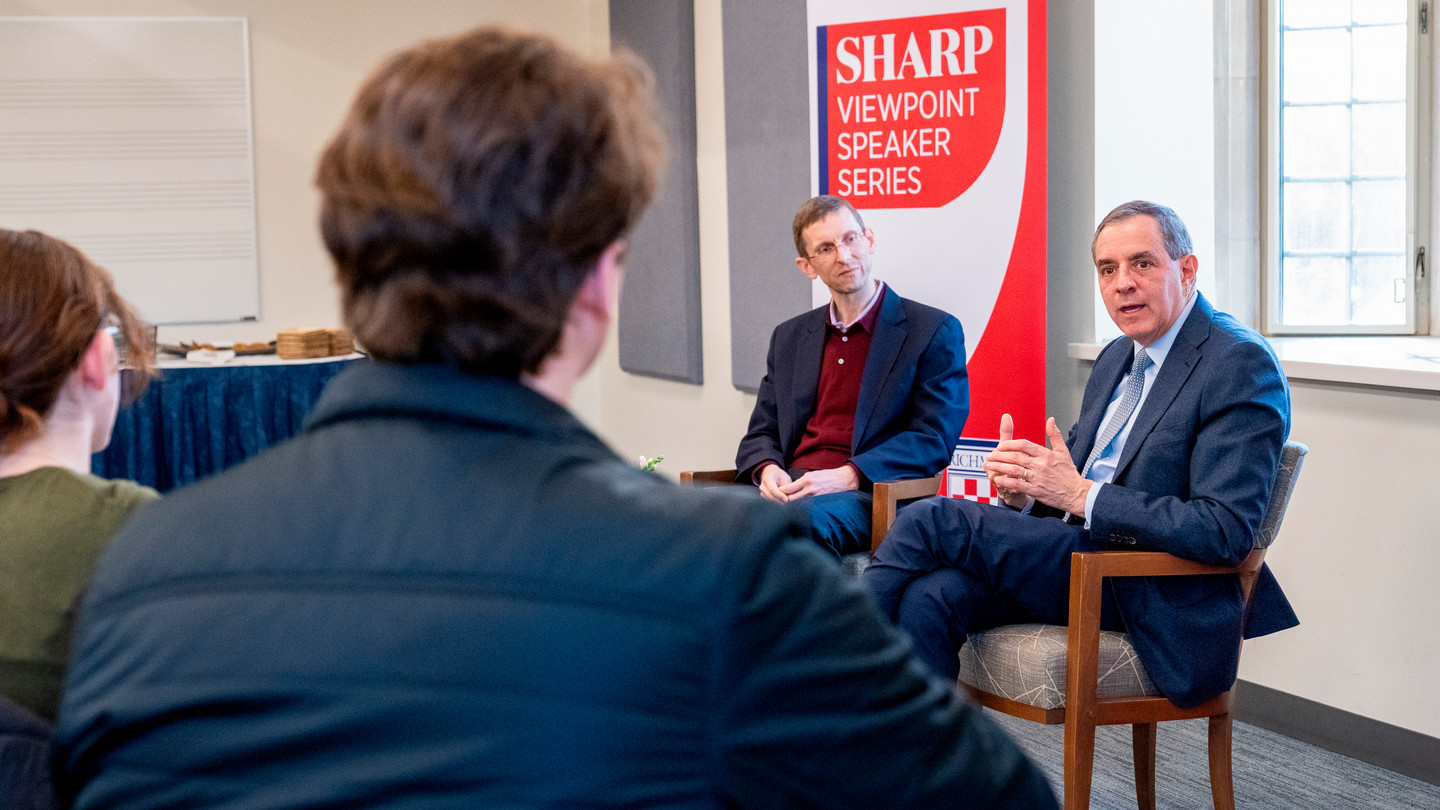
Leading economists explore what AI means for work, wages, and human flourishing.
Signature speaker series and special events provided valuable opportunities for Spiders to dive further in, considering topics from different angles.
Leading economists took center stage at the Modlin Center for the Arts to explore distinct perspectives for AI and The Future of Work, as part of the Sharp Viewpoint Speaker Series.
David Autor of the Massachusetts Institute of Technology, a leading scholar of how technology reshapes labor markets, and Anton Korinek of the University of Virginia, named to the 2025 TIME100 list of the most influential people in artificial intelligence, presented their viewpoints and engaged in a civil debate, moderated by University President Kevin F. Hallock.
“We should certainly be both optimistic and pessimistic,” Autor said. “We are at the dawn of possibilities.” Autor noted that powerful new technologies can take decades to diffuse, so labor shifts across sectors will likely unfold gradually.
But, because machines can learn both quickly and cheaply, changes could be swift, Korinek said. “We are living through the AI take-off right now, and this may accelerate the labor share decline significantly as AI learns and can do more and more human skills.”
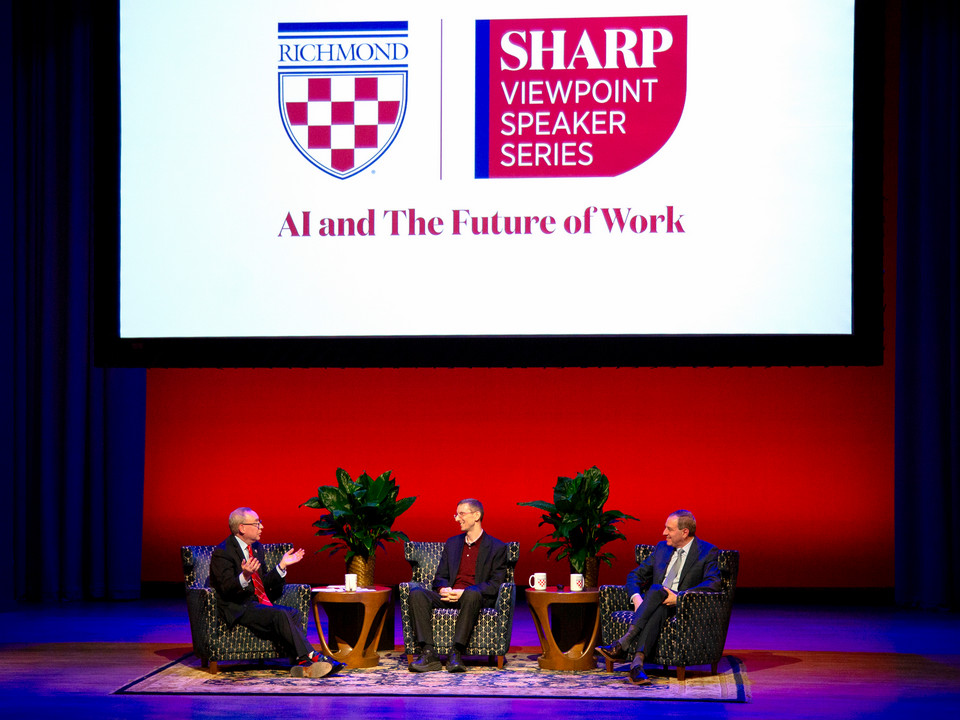
Prior to the event, a small group of undergraduates attended a special engagement session with Autor and Korinek, and the following day, a campus-wide conversation brought together students, staff, and faculty to debrief and discuss how an academic community can flourish and achieve its educational mission in an AI-enabled world.
A video of the talk is now available.
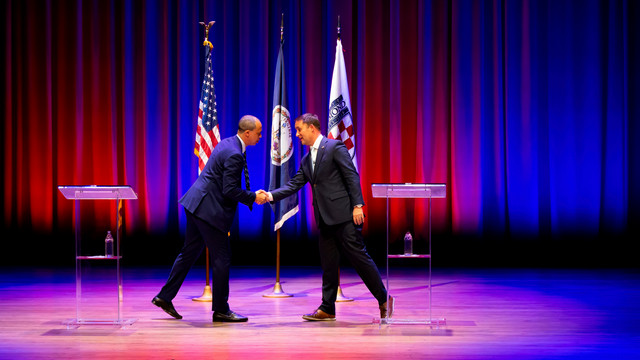
University hosts 2025 Virginia Attorney General Debate.
Showcasing different perspectives on democracy today, in the fall, the University of Richmond School of Law, in partnership with the Virginia State Bar Association, hosted the 2025 Virginia Attorney General Debate.
Candidates Jason Miyares and Jay Jones presented their platforms, addressed key issues, and answered questions of interest to Virginia voters.
“This event offered our students and the broader Richmond community a front-row seat to the democratic process,” said Wendy Perdue, dean of the University of Richmond School of Law.
“Debates like this remind us that public discourse can be passionate yet civil, and that engaging directly with differing ideas is at the heart of both democracy and education.”
“This event offered our students and broader Richmond community a front-row seat to the democratic process.”
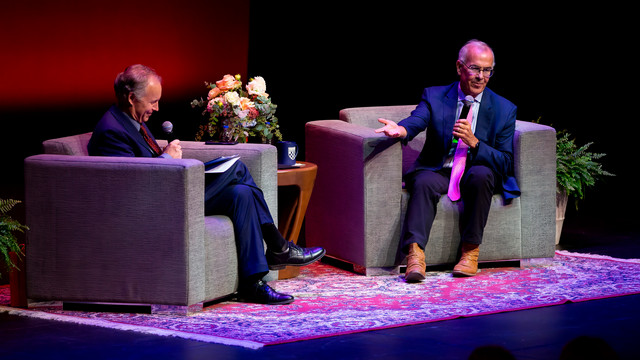
David Brooks challenges Spiders to be “defiantly human.”
Bestselling author, PBS NewsHour commentator, and The New York Times opinion columnist David Brooks served as the keynote speaker for the 38th annual Weinstein-Rosenthal Forum on Faith, Ethics, and Global Society.
Brooks provided guidance on how to foster genuine connections in a society he described as “plagued by loneliness and fragmentation,” the focus of his latest bestseller, How to Know a Person: The Art of Seeing Others Deeply and Being Deeply Seen.
“A lot of conversations today are hostile,” Brooks said. He emphasized the importance of reclaiming conversations and social trust and shared some tips:
- Be a good listener by demonstrating active interest.
- Don’t fear the pause. Give people time to think.
- Don’t be a topper, someone who constantly tries to one-up or redirect attention to themselves during a conversation.
- Ask good questions.
He encouraged the audience to strive to be “defiantly human.”
Dialogue in Action
Students share their own perspectives about our current moment.
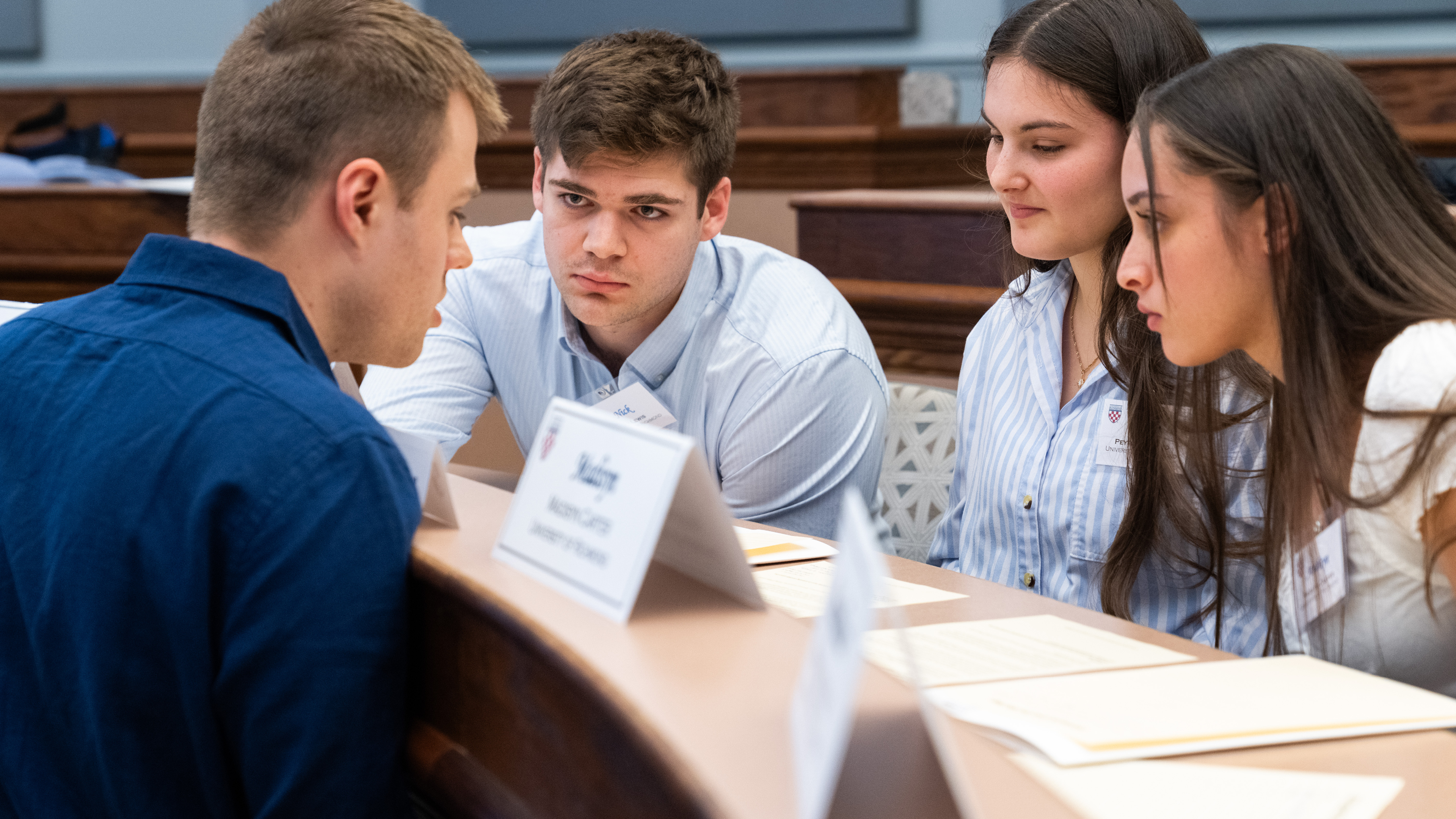
Students exchanged ideas during the 26th Annual Virginia Foundation for Independent Colleges Applied Ethics Bowl, which brought 16 teams from across the state to campus to put their learning into practice.
Richmond students engaged deeply with important topics of our time — sharing reflections and having thoughtful dialogues. Whether discussing politics, business ethics, or the decisions of their university, Spiders demonstrated civility as they explored big questions from multiple perspectives this year.
McDowell Institute promotes the vigorous exchange of ideas.
Intentional time and space dedicated to free inquiry, thoughtful deliberation, and rigorous discussions are the cornerstone of the University’s Gary L. McDowell Institute. Named for a former professor of leadership studies, the institute honors the memory of Gary McDowell through its commitment to the civil exchange of diverse viewpoints on issues in governance, economics, and law.
Programming includes guest speakers, seminars, and conferences. Housed in the Jepson School of Leadership Studies, with cross-school leadership it serves as a University hub to support the exchange of ideas among faculty and students. Dan Palazzolo, a professor of political science, and Terry Price, Coston Family Chair in Leadership and Ethics, co-direct the institute.
“The structure of the institute — co-directors, student fellows, and faculty discussion leaders drawn from different schools — exemplifies one of the core values of the institute: to welcome all members of the University community and a wide range of political perspectives,” said Palazzolo.
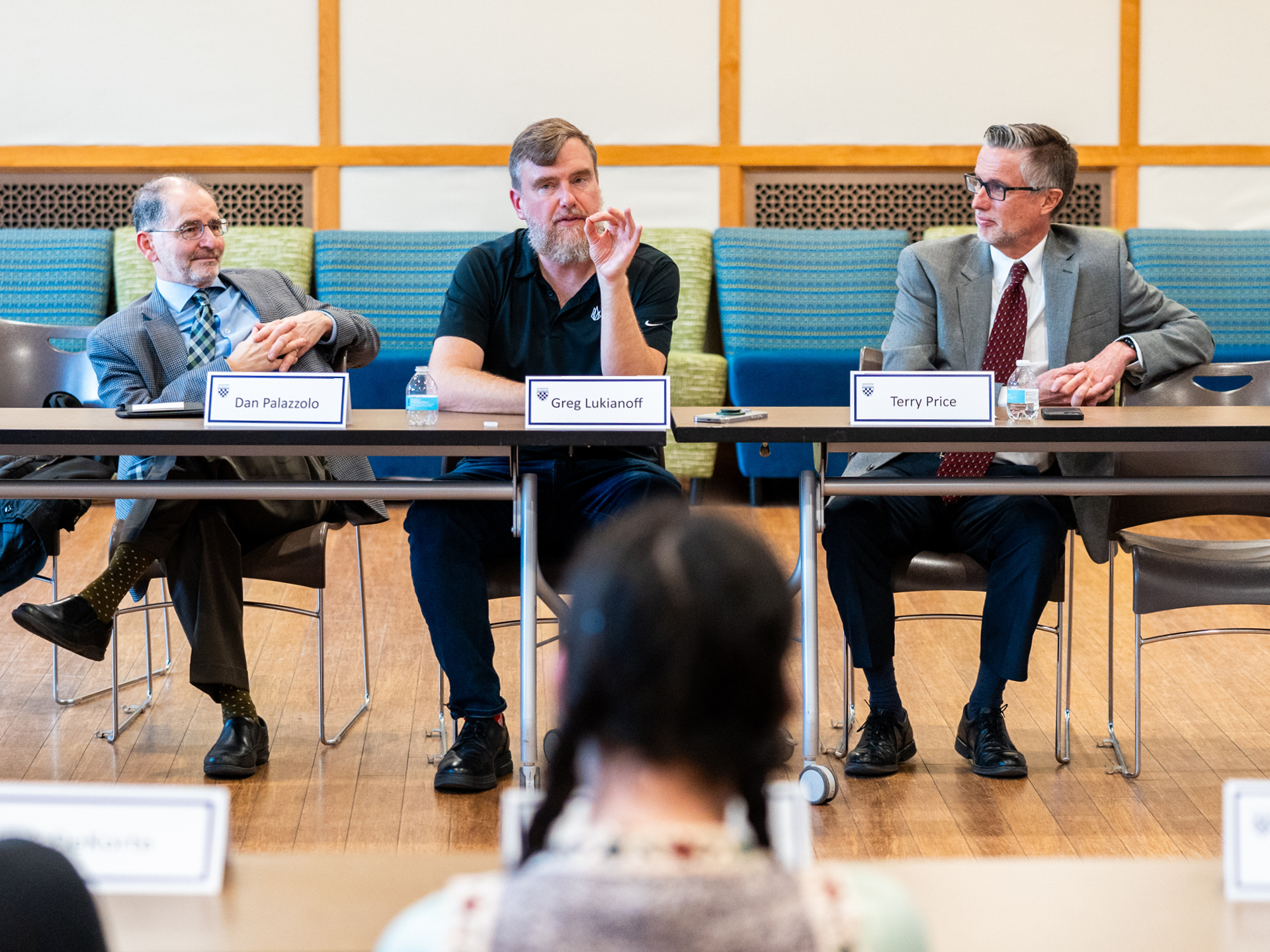
Greg Lukianoff, president and CEO of the Foundation for Individual Rights and Expression (FIRE), served as the institute’s inaugural practitioner-in-residence in 2025. On Nov. 18, he met with students and gave a public presentation on free speech in higher education.
Lukianoff praised students he met for their thoughtful inquiry, noting “all of the questions were top-notch.”
“Today we have greater awareness of free speech on college campuses — but a lot less free speech,” Lukianoff said, attributing this paradox to a lack of diverse opinions among faculty. “We need to kick the tires, have more structured friction, more political diversity in higher education. We could benefit from implementing listening projects, where the goal is not to change someone’s mind, but to listen and understand the perspective of someone who holds a different view.”
The institute launched a student fellows program in 2020–21 with an inaugural cohort of 20 fellows. Today, the program is 59 fellows strong.
“Student fellows read works from ideological perspectives that are typically underrepresented in the classroom,” said Price. “Our fellows are diverse in their own politics but clearly appreciate exposure to the ideas of people with whom they disagree. They are not always convinced, but they learn how to read and listen carefully and disagree constructively — something a Richmond graduate should be able to do.”
This year, the fellows read The New York Times opinion columnist Ross Douthat’s book Believe: Why Everyone Should Be Religious. He gave a public lecture on the same topic on March 26, and referred to the Spider students he spoke with as “some of the brightest young minds in America.”
“We want students, faculty, and staff to have the opportunity to hear some of the nation’s most interesting, thoughtful writers speak to important enduring and contemporary issues,” Palazzolo said.
“All of the questions were top-notch.”
Ethics Bowl team considers questions around business ethics.
In the spring, students exchanged ideas during the 26th annual Virginia Foundation for Independent Colleges Applied Ethics Bowl, which brought 16 teams from across the state to campus to put their learning into practice.
Teams presented their analyses of complex “Ethics in Business” cases to panels of judges from business, legal, and education professions and networked with community leaders.
“Taking part in the experience helps students think clearly about real-world cases and apply what they’ve learned in their ethics, philosophy, and other classes,” said philosophy professor Brannon McDaniel, who has advised UR’s Applied Ethics Bowl club for 15 years. “They can start to see how patterns of reasoning apply to cases they're likely to face on the job or in other circumstances.”
President’s Forum invites student input and conversation with campus leaders.
Students also demonstrated thoughtful inquiry during the February 2026 President’s Forum held by UR’s chapter of Mortar Board, a national college honor society that recognizes juniors and seniors for scholarship, leadership, and service.
An annual tradition, the student-led Mortar Board offers students an opportunity to hear directly from campus leadership, including the University president, and ask questions about what matters most to them.
Throughout the forum, President Hallock, Westhampton College Government President Karine Nguyen, ’26, and Richmond College Government President Sassan Fahim, ’26, took turns fielding questions across a wide range of topics, from the two-college system to campus safety to the role of AI at Richmond.
Mortar Board received a Project of Excellence Award from the national chapter in the category of “Leadership” for their President’s Forum event held in 2025. Learn more here.


